
Quick answer
A student may get a math answer right by remembering a procedure, copying a pattern, using a tool, or guessing. Real understanding appears when the student can explain why the method works, adapt to a changed problem, use another representation, analyze an error, and judge whether the answer is reasonable.
A correct answer feels reassuring. But a student may remember a procedure, copy a nearby pattern, use a calculator correctly, or guess well.
The difficulty often becomes visible only when wording changes, numbers are less convenient, or the concept appears inside a more advanced lesson.
Procedure and understanding are not the same
Procedural skill answers “What steps do I follow?” Conceptual understanding answers “Why do those steps work?” Students need both.
A child may know to move the decimal when multiplying by a power of ten but be unable to explain what happens to each digit’s value. Understanding helps students choose methods, catch unreasonable answers, and apply skills in new settings.
Five ways to check for real math understanding
1. Ask for an explanation
“Tell me how you solved it.” Listen for connections between the steps, not perfect vocabulary.
2. Change the problem slightly
If the question asks for 25% of 80, ask: “Twenty is what percent of 80?” Understanding adapts; memorized sequences often do not.
3. Ask for another method
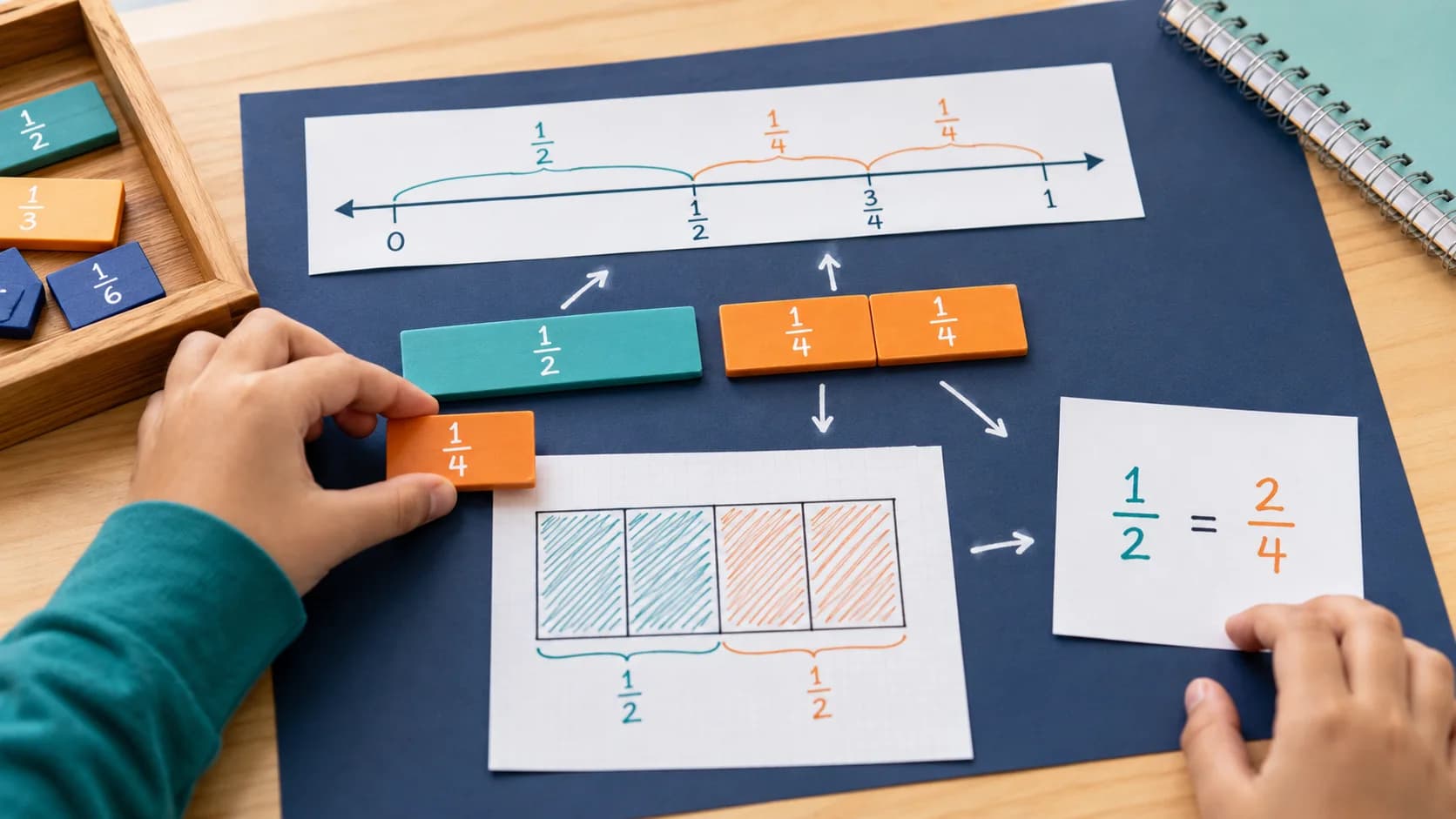
Try a picture, number line, table, equation, or mental math.
4. Include an incorrect example
Ask what mistake another student may have made. Error analysis requires deeper reasoning than repetition.
5. Ask whether the answer is reasonable
Estimation and number sense should expose contradictions, such as a discounted item costing more than its original price.
Warning signs of a hidden gap
- Cannot start without an example
- Small wording changes cause confusion
- Correct steps cannot be explained
- Previously learned skills disappear
- Word problems are much harder than calculations
- Foundational errors recur
- Confidence falls as topics become complex
Why gaps grow over time
Math is cumulative. Fractions support proportions, number sense supports algebra, and algebraic reasoning supports higher math and science. More practice on the current lesson may not repair a missing prerequisite.
From correct answers to transferable skills
At GrowWise, progress means a student can explain, apply, and retain a concept—not merely complete another worksheet.