
Common Core math can feel unfamiliar because the homework may ask for a drawing, model, or written explanation when an adult remembers solving the same problem with one stacked algorithm. The model is not meant to make arithmetic needlessly complicated. It is meant to reveal place value, relationships, and reasoning that a shortcut can hide.
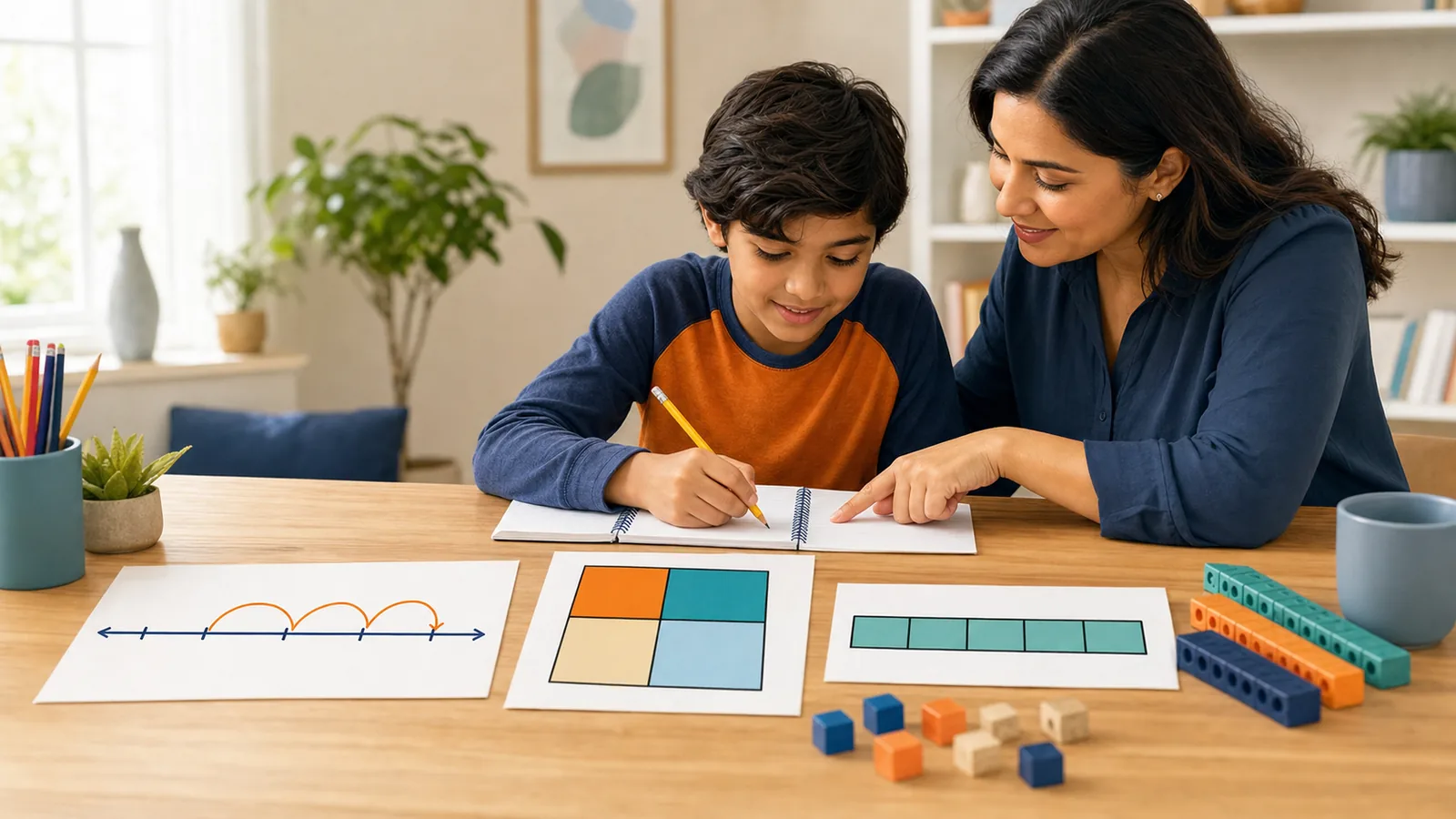
What is Common Core math trying to build?
Common Core math aims to develop both understanding and fluency. Students should calculate accurately, but they should also make sense of problems, represent quantities, explain reasoning, choose useful tools, and check whether an answer is reasonable.
The official Standards for Mathematical Practice emphasize problem solving, quantitative reasoning, modeling, precision, and recognizing structure. That is why students may be asked to solve one problem in more than one way.
For example, a student should eventually know that 24 × 13 = 312. Before treating the procedure as a set of steps, the student should also see that the problem can be decomposed into 24 × 10 and 24 × 3, estimated, modeled, and checked.
| Strategy | Best used for | A useful parent question |
|---|---|---|
| Number line | Addition, subtraction, fractions, decimals, elapsed time, and negative numbers | “Where did you start, and why did you choose those jumps?” |
| Area model | Multi-digit multiplication, fractions, place value, and the distributive property | “What does each section represent, and how do the partial products combine?” |
| Bar model or tape diagram | Word problems, comparison, equal groups, missing parts, fractions, and ratios | “What relationship does the drawing show before you choose an operation?” |
| Place value decomposition | Regrouping, mental math, addition, subtraction, multiplication, and decimals | “What is the value of each digit, and how can you break the number apart?” |
1. How does a number line strategy work?
A number line shows numbers in order and makes movement, distance, and magnitude visible. Students can use it for addition, subtraction, elapsed time, fractions, decimals, and negative numbers.
Example: 38 + 27
- Start at 38.
- Jump forward 20 to reach 58.
- Jump forward 7 to reach 65.
- Therefore, 38 + 27 = 65.
The important idea is not the drawing itself. The child is decomposing 27 into 20 and 7 and tracking how each part changes the total. A useful parent prompt is: “Why did you choose those jumps?”
2. What is an area model?
An area model is a rectangle divided into sections. Each section represents one partial product, helping students connect multi-digit multiplication to place value and the distributive property.
Example: 23 × 14
20 × 10 = 200
20 × 4 = 80
3 × 10 = 30
3 × 4 = 12
200 + 80 + 30 + 12 = 322
This is the same mathematics that appears inside the standard multiplication algorithm, but the place-value parts remain visible. Later, the same structure supports fraction multiplication and algebraic expressions.
3. What is a bar model or tape diagram?
A bar model, also called a tape diagram, uses rectangular bars to show how quantities relate. It is especially useful when a child can calculate but does not know which operation a word problem needs.
Suppose Lena has 24 stickers and Maya has three times as many. One bar represents Lena's 24. Three equal bars represent Maya's amount, so the relationship is 24 × 3 = 72.
Before discussing an operation, ask: “What is happening between these quantities?” The student should identify whether the problem shows a total, a missing part, a comparison, equal groups, or a multiplicative relationship.
4. What is place value decomposition?
Place value decomposition means breaking a number into the value represented by each digit. For example, 456 = 400 + 50 + 6. This helps students understand regrouping instead of treating “carrying” or “borrowing” as unexplained rules.
To solve 456 + 238, a student can add hundreds, tens, and ones: 400 + 200 = 600, 50 + 30 = 80, and 6 + 8 = 14. Combining the parts gives 694.
5. What are partial products?
Partial products are the smaller multiplication results that make up a larger product. For 34 × 6, a student can calculate 30 × 6 = 180 and 4 × 6 = 24, then combine them to get 204.
Partial products also make estimation easier. Since 34 × 6 is slightly more than 30 × 6, an answer near 180 is reasonable; an answer such as 2,040 should trigger a place-value check.
Do students still need the standard algorithm?
Yes. Visual models are a bridge to efficient and accurate procedures, not a permanent replacement for them. A strong progression is: understand the quantities, model the relationship, explain the reasoning, connect the model to an equation, and then use an efficient algorithm fluently.
Students are ready to rely less on a model when they can choose the operation, explain what the numbers mean, estimate the result, calculate accurately, and check whether the answer makes sense.
Common mistakes parents make when helping
Teaching only the shortcut
“Let me show you the faster way” may produce tonight's answer while making the classroom method more confusing. Ask what strategy the teacher expects, understand that strategy first, and then show how it connects to the familiar algorithm.
Searching for keywords in word problems
Rules such as “altogether means add” fail when problems become more complex. Help the child identify what is known, what is unknown, and how the quantities relate before choosing an operation.
Doing the thinking for the child
A parent can make every step look clear while the child remains passive. Pause after each prompt and let the child decide what happens next.
Treating every model as unnecessary extra work
A model earns its place when it reveals the source of an error. A tape diagram can expose a mistaken comparison, an area model can reveal a missing partial product, and decomposition can uncover weak place value.
A five-step homework routine for parents
- Read the problem aloud. Slow down long or multi-step directions.
- Name the goal. Ask what the problem wants the student to find.
- Choose a representation. Use a number line, area model, bar model, or place-value chart when it clarifies the relationship.
- Connect the model to an equation. The drawing and symbols should describe the same mathematics.
- Check for independence. Change the numbers and ask the child to solve a similar problem without copying.
Questions that help without giving away the answer
- What do you know?
- What are you trying to find?
- What does this part of the model represent?
- Why did you choose that operation?
- Can you estimate before calculating?
- Does your answer make sense?
Signs your child may need extra math support
Extra support may help when a child repeatedly calculates correctly but cannot solve word problems, chooses operations by guessing, makes persistent place-value errors, forgets a method quickly, or cannot solve a similar problem after following an example.
These patterns do not necessarily mean the child is not trying. They often point to a specific gap in number sense, language, representation, or prerequisite knowledge. GrowWise uses assessment and error patterns to identify that gap rather than simply assigning more of the same worksheet.
Families in Dublin, Pleasanton, San Ramon, Livermore, and nearby Tri-Valley communities can explore our math programs or book a free assessment to identify the concept that needs attention.
The bottom line
Common Core math strategies are useful when they make thinking visible. Number lines show movement, area models reveal place value in multiplication, bar models clarify word-problem relationships, and decomposition explains regrouping. The parent's most valuable job is not to supply a faster answer—it is to ask the question that helps the child see the mathematics.
Common Core Math FAQ for Parents
Why does Common Core math look so different?
Common Core math often looks different because students are asked to show their thinking with models, drawings, number lines, equations, and explanations. The goal is to build conceptual understanding and procedural fluency, not to reject efficient standard methods.
Is Common Core math harder than traditional math?
It can feel harder at first because students must explain why a method works. The extra reasoning is intended to help students transfer their skills to unfamiliar and multi-step problems instead of relying only on memorized steps.
Should parents teach the traditional algorithm at home?
Parents can discuss the traditional algorithm, but they should first help the child use the strategy requested by the teacher. Once the child understands the place value or model behind the problem, connect that reasoning to the efficient algorithm.
What is an area model in math?
An area model is a rectangle divided into smaller sections to show how a multiplication problem can be decomposed. For 23 × 14, the sections represent 20 × 10, 20 × 4, 3 × 10, and 3 × 4.
What is a bar model or tape diagram?
A bar model, also called a tape diagram, uses rectangular bars to show relationships between quantities. It helps students see totals, missing parts, comparisons, equal groups, fractions, and ratios before choosing an operation.
Why can my child calculate but still struggle with word problems?
Calculation and problem representation are different skills. A child may know a procedure but still struggle to identify what is known, what is unknown, how quantities relate, or which operation matches the situation.
When should a child stop using math models?
A child can rely less on drawings when they can explain the concept, choose an efficient strategy, calculate accurately, and check whether the answer is reasonable. Models should build understanding and remain available when a new or difficult problem calls for them.