
Some children sound like strong readers because they pronounce words accurately and read at a steady pace. Yet when asked what the passage means, they give a vague answer, repeat one detail, or say, “I don’t know.” This is a comprehension problem, not proof that the child was not paying attention.
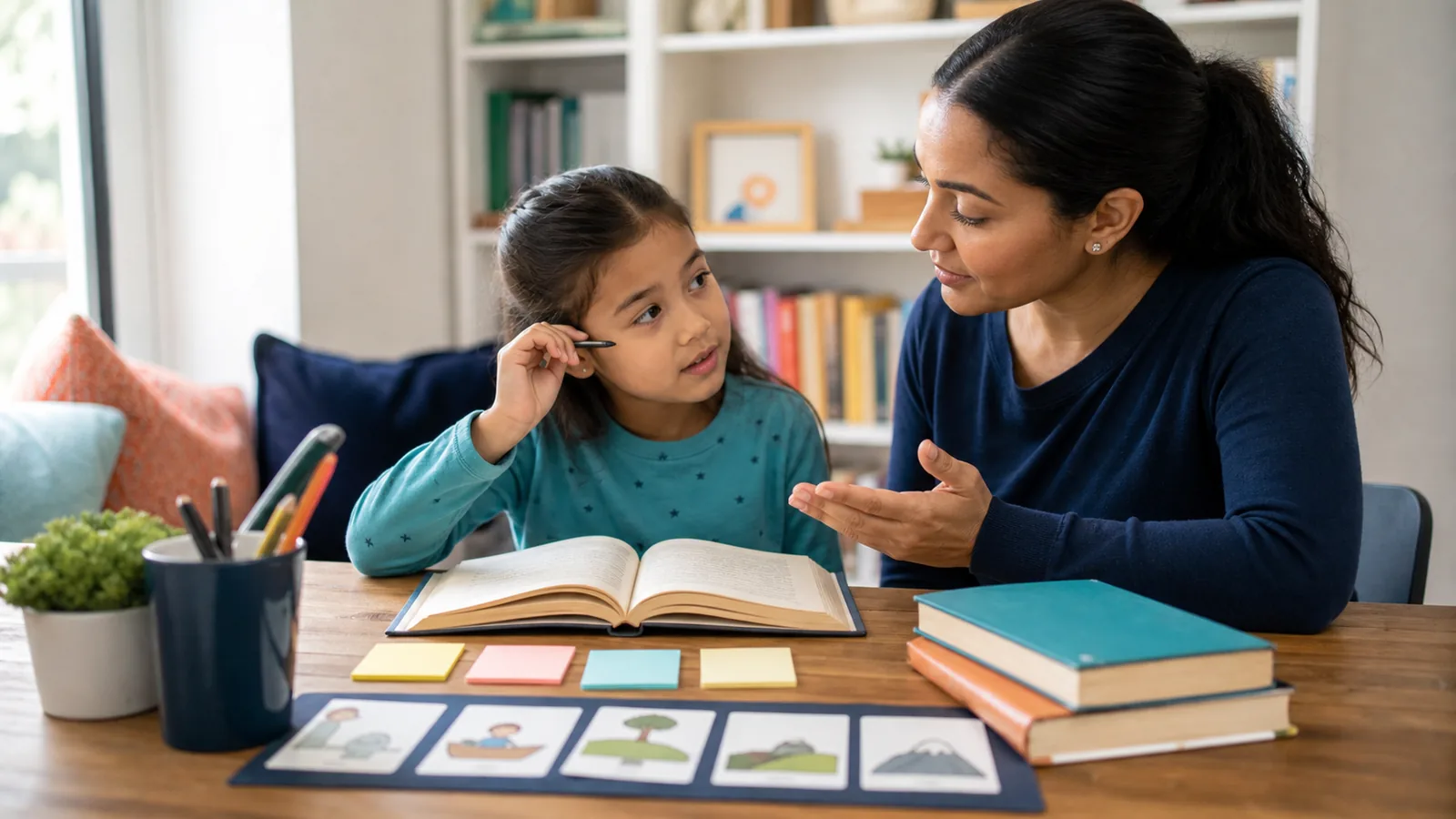
Why is reading words different from understanding?
Reading comprehension requires children to recognize words and build meaning from them. They must connect sentences, understand vocabulary, use background knowledge, remember important details, make inferences, and notice when something does not make sense.
Reading Rockets explains this distinction in its overview of reading comprehension. The U.S. Department of Education's guide on improving reading comprehension recommends teaching comprehension strategies, discussing text deeply, selecting purposeful text, and creating an engaging context for reading.
Sign #1: your child cannot retell the passage
A retell shows whether the child formed a coherent mental model. If the retell contains disconnected details, leaves out the central problem, or follows the wrong sequence, the child may be reading sentence by sentence without connecting ideas.
Ask: “Tell me what happened first, next, and last,” or for nonfiction, “What were the three most important things the author explained?”
Sign #2: your child misses the main idea
The main idea is not simply the first sentence or the most interesting fact. It is the central message supported by key details. A child who lists facts but cannot state what they have in common may need explicit practice grouping details under one larger idea.
Sign #3: your child guesses answers
Guessing often sounds plausible but has no textual support. Ask the child to point to the sentence, phrase, or event that supports the answer. If no evidence exists, return to the passage rather than debating the guess.
Sign #4: inference questions cause trouble
An inference combines text evidence with relevant background knowledge. If a character slams a door and answers in short sentences, the author may never state the emotion directly. The child must notice clues and explain what those clues suggest.
Use an evidence sentence
Have your child answer with: “I think ___ because the text says ___.” This separates evidence-based inference from unsupported guessing.
Vocabulary or comprehension: how can parents tell?
Choose two or three important words from the passage. Ask the child to explain them in context. If understanding improves once those words are taught, vocabulary was a major barrier. If the words are known but the child still cannot connect events, identify the main idea, or explain cause and effect, broader comprehension support is needed.
Why does background knowledge matter?
Readers understand new information by connecting it to what they already know. A passage about migration, ecosystems, or a historical event becomes harder when the child lacks the concepts needed to interpret it. Briefly previewing the topic, images, headings, and essential vocabulary can make the text more accessible without giving away its meaning.
Questions parents should ask after reading
- What was this passage mostly about?
- Which detail is most important, and why?
- What caused the main event or problem?
- What changed from the beginning to the end?
- What can you infer that the author did not state directly?
- Which sentence or example supports your answer?
- What part was confusing, and what could you reread?
Ask one or two questions during a normal reading session, not all seven as an interrogation. The goal is thoughtful conversation and increasing independence.
What should parents avoid?
Do not respond only by assigning more worksheets. A worksheet may reveal that answers are wrong without teaching how to summarize, infer, monitor understanding, or use evidence. Avoid texts that are so difficult that nearly every sentence requires rescue, and do not accept a fast answer without asking how the child knows.
How does GrowWise build reading comprehension?
Effective comprehension instruction makes invisible thinking visible. At GrowWise, students practice retelling, main idea, vocabulary in context, sentence and paragraph connections, inference, evidence, and written responses. Teachers model the strategy, guide practice, study error patterns, and gradually remove support.
If your child reads fluently but struggles to explain what they read, explore our elementary English program, review our guide to reading fluency versus comprehension, or book a free reading assessment.
Reading Comprehension FAQ
Why can my child read the words but not understand the passage?
Accurate word reading and comprehension are related but different skills. Understanding also depends on vocabulary, background knowledge, attention, sentence structure, inference, memory, and the ability to monitor whether the text makes sense.
Can a child read fluently and still have poor comprehension?
Yes. A child may sound smooth and accurate while focusing on pronunciation rather than meaning. Ask for a retell, main idea, supporting evidence, and an inference to check whether fluent reading is producing understanding.
How can I tell whether vocabulary is the problem?
Ask the child to explain important words from the passage in their own language. If understanding improves after two or three key words are taught, vocabulary is likely contributing. If the child knows the words but cannot connect ideas, the gap may be broader comprehension.
What questions improve reading comprehension?
Ask what happened, what the passage is mostly about, which detail proves the answer, why a character acted that way, what caused an event, and what the child predicts next. Require the child to point back to the text.
Are more reading-comprehension worksheets the solution?
Not by themselves. Worksheets can measure answers without teaching the missing skill. Effective support models how to summarize, infer, clarify vocabulary, connect ideas, and use evidence, then gradually transfers that work to the child.
When should I seek reading-comprehension help?
Seek targeted support when a child repeatedly cannot retell grade-level text, misses main ideas, guesses without evidence, struggles across subjects, or becomes increasingly frustrated despite regular reading practice.