
Here's what grades actually measure — and what they quietly miss.
Your child brings home a B+ in math. You feel good. They feel okay about it. Life moves on.
But here's what the B+ doesn't tell you: whether your child actually understandsthe math, or whether they've learned to work around the parts they don't.
These are not the same thing. And in competitive school districts, the gap between them tends to stay hidden — until it suddenly isn't.
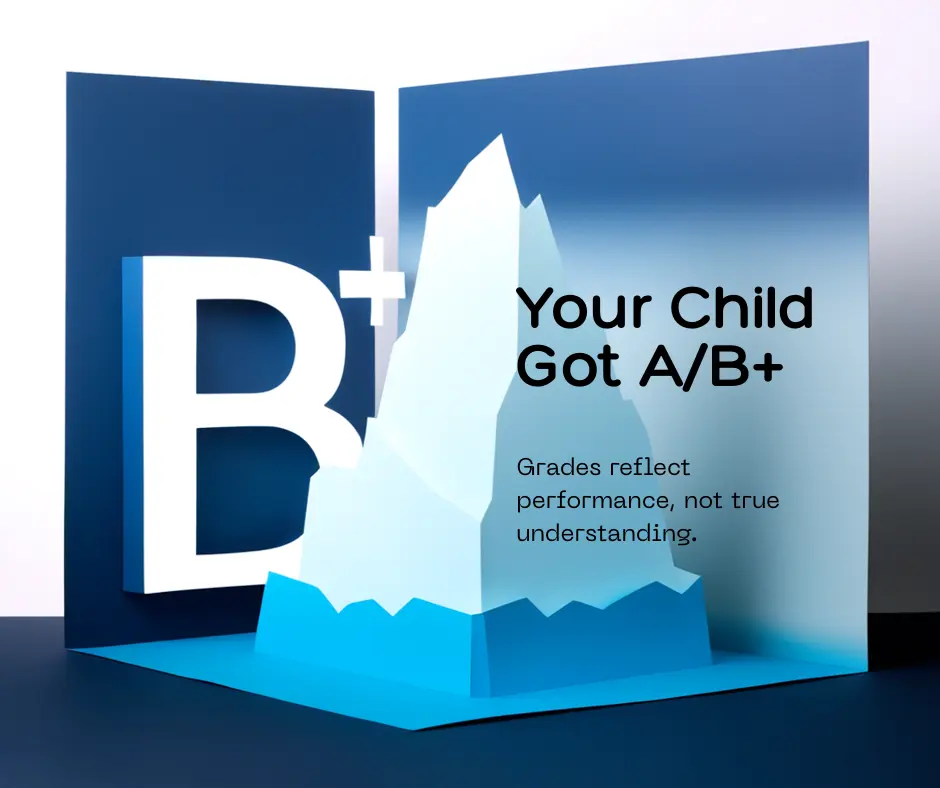
What do grades measure, and what do they miss?
A grade reflects how a student did on the specific material taught that quarter. It rewards memorization, effort, test-taking skill, and homework completion. It does not — and cannot — tell you whether the underlying concept has been genuinely understood or quietly patched over.
Research from the National Mathematics Advisory Panel identifies three distinct types of student errors: slips (random mistakes that self-correct), bugs (wrong rules applied consistently), and gaps (missing conceptual understanding that persists even after re-teaching).
Slips show up as grade deductions. Bugs and gaps often don't — because students learn to compensate.
A student who doesn't understand why fractions work the way they do can still score well on a fractions test. They memorize the steps. They pattern-match from examples. They get the right answer by the wrong reasoning — until the material builds on itself and the patch no longer holds.
The grade that hides the gap
Here's a pattern that plays out often in Grades 5 through 7.
A student moves through elementary math performing adequately. They get Bs and Cs. No alarm bells. Parents assume the school is handling it. The student assumes they're "not a math person" and adjusts expectations accordingly.
What no one sees: the student has a fundamental misconception about how fractions work — specifically, that a bigger denominator means a bigger fraction (1/8 > 1/5, because 8 is bigger than 5). This belief formed in Grade 3 and was never directly corrected.
On its own, in a Grade 3 context, this misconception rarely tanks a grade. The tests don't always surface it. The student works around it.
By Grade 7, that same student is struggling with ratios, proportions, and pre-algebra — topics that all depend on fraction fluency. Their grades slide. They feel behind. The cause is traced to "they're not good at math," not to a specific, fixable misconception that has been compounding quietly for four years.
This is not unusual. Studies of math error patterns show that some of the most consequential misconceptions — particularly around fractions, place value, and algebraic thinking — are highly persistent precisely because they are easy to hide behind correct-looking procedures.
Why Tri-Valley parents should care about this specifically
Academic pressure in districts like Dublin, Pleasanton, and San Ramon starts early and compounds. Students here are compared to cohorts where a significant percentage are already ahead. When a gap exists, there's less slack — the curriculum moves fast, class sizes are large, and teachers rarely have time for individual diagnostic work.
The students most at risk are not the ones clearly struggling. They're the ones performing just well enough that no one looks closer.
A student who is "getting by" in Grade 5 with an undiagnosed fraction gap is likely to hit a wall in Grade 7 algebra that feels sudden but wasn't. The grade didn't predict it. The grade never could.
What actually reveals a gap
Gaps surface when you change the form of the question — not when you repeat it.
A student who has memorized fraction procedures will fail if you ask them: "Which is larger — one-fifth or one-eighth?" and require them to explain why without calculating. A student who genuinely understands fractions will answer correctly and explain that fewer cuts means bigger pieces.
That's the difference between procedural performance and conceptual understanding. One shows up on grades. The other shows up when the underlying thinking is tested directly.
The most effective way to surface a gap — without a formal assessment — is to ask your child to explain their reasoning, not just their answer. Wrong answers with confident, logical-sounding explanations are usually bugs or gaps, not slips. Slips come with uncertainty. Bugs come with conviction.
What to do if you suspect a gap
Start with observation, not alarm. Ask your child one or two conceptual questions in the area you're curious about. Not "what is 3/5 + 2/5?" — but "which fraction is bigger, and how do you know?"
If you're not sure what to listen for, use the parent guides below — the same patterns as our free Detective Challenge self-check. Each maps to a known high-risk gap and shows what a red-flag answer sounds like.
Parent guides: fraction gaps (most common behind a B+)
Gets confused when comparing fractions
What this actually means
This is the most common and most consequential fraction misconception. It forms in Grade 3 and, if not corrected, directly blocks ratios, proportions, and pre-algebra in Grades 6–8. The confusion comes from applying whole-number thinking to fractions — bigger number means bigger value — which is true for whole numbers and completely wrong for denominators.
Ask your child
"Which is bigger — one-fifth or one-eighth? How do you know?"
Correct thinking
One-fifth. Explanation: "If you cut something into 5 pieces, each piece is bigger than if you cut it into 8 pieces."
Red flag answer
"One-eighth, because 8 is bigger than 5." Or a correct answer with the wrong reason: "one-fifth, because 1 and 5 are smaller numbers."
Follow-up check
"Is 3/4 bigger or smaller than 5/8?"
Correct: 3/4 (common denominator or reasoning: 3/4 = 6/8 > 5/8).
Red flag: 5/8, "because 5 and 8 are bigger numbers."
What happens downstream
Fraction comparison is the entry point for rational number fluency. Students who can't reliably compare fractions cannot reliably order them, add them, or work with them in proportion problems. Research documents this misconception appearing in students through high school — and even in some adults. It requires direct conceptual correction, not just more practice.
On the free math self-check, select: Gets confused when comparing fractions
Adds fractions the wrong way
What this actually means
This is the most documented fraction bug in math education. The child applies whole-number addition logic to fractions — adding tops and adding bottoms — which produces a consistent, confident wrong answer. The insidious part: students who do this often feel they've done it correctly. It's a systematic bug, not a careless mistake.
Ask your child
Write on paper: 1/2 + 1/3 = ?
Correct thinking
5/6. Child found a common denominator (6), converted both fractions, then added numerators only.
Red flag answer
2/5. Child added 1+1=2 (numerators) and 2+3=5 (denominators). Answer feels logical to them.
Follow-up check
Write: 2/4 + 1/4 = ?
Correct: 3/4. Same denominator — just add numerators.
Watch for: child who gets this right but did the previous one wrong may not understand why — they only recognize same-denominator cases as a separate rule.
What happens downstream
This bug blocks all algebraic fraction work, rational expressions in Algebra 2, and any application involving rates, ratios, or measurement. It is almost always persistent — students repeat it consistently on tests because the procedure feels right to them. It requires explicit reteaching of what a fraction denominator actually means (part size, not a count), not just the correct algorithm.
On the free math self-check, select: Adds fractions the wrong way
Same labels as our Detective Challenge
The free self-check uses these exact options. Pick what sounds like your child, then compare to the quiz result.
- Forgets negative signs — Slip vs. bug — same sign error twice means a pattern.
- Lines up numbers incorrectly — Place value — partial products must shift left.
- Solves left to right instead of following the correct order — PEMDAS — multiply before add, not left to right.
- Puts the decimal point in the wrong place — More digits after the decimal does not always mean bigger.
- Gets confused when comparing fractions — Bigger denominator can mean smaller pieces.
- Adds fractions the wrong way — Adding tops and bottoms (e.g. 2/5) is a systematic bug.
- Understands in class but makes mistakes on tests — Class follow-along vs. test retrieval are different skills.
Try GrowWise's free parent self-check — a 10-minute diagnostic that flags the exact mistake pattern, not just a general score.
Start the Free Self-CheckFor a deeper look at spotting gaps at home, see our guide on identifying learning gaps at home.
A gap found in Grade 5 takes weeks to fix. The same gap found in Grade 8 takes months — and costs confidence along the way.
The B+ doesn't know that. But you can.
Ready to go deeper?
GrowWise School runs small-group math programs for students in Grades 3–12 in Dublin, CA. Programs are project-based, curriculum-aligned, and focused on genuine understanding — not test prep.
GrowWise School runs small-group math programs for students in Grades 3–12 in Dublin, CA. Programs are project-based, curriculum-aligned, and focused on genuine understanding — not test prep. Learn more at growwiseschool.org.
Frequently asked questions about grades, math gaps, and enrichment in Dublin CA
Parent questions we hear in Tri-Valley — same topics as our free math self-check. Tap to expand.
More for Tri-Valley families: GrowWise blog · Free math self-check