
Telling a student to get off screens during homework sounds reasonable until the assignment, textbook, teacher messages, and submission portal all live on a screen.
The better question is not how to remove every device. It is which digital behaviors are interrupting the work and what boundary can reduce them.
The short answer
Homework focus is usually disrupted less by the school laptop itself than by switching between the assignment and messages, videos, games, or social media. Keep required technology available, turn off nonessential notifications, move the phone out of reach, close unrelated tabs, and use planned check breaks. Build the rule with your child and model it yourself.
Which screen behavior is causing the problem?
Observe before setting a rule. Is your child opening entertainment tabs, responding to every notification, using a phone while the laptop loads, or avoiding a confusing task by searching endlessly? Each pattern needs a different fix.
The American Academy of Pediatrics now emphasizes context, content, and family conversation rather than one simple number for every child. During homework, the aim is to protect learning and sleep while keeping necessary tools usable.
What does a realistic homework screen plan include?
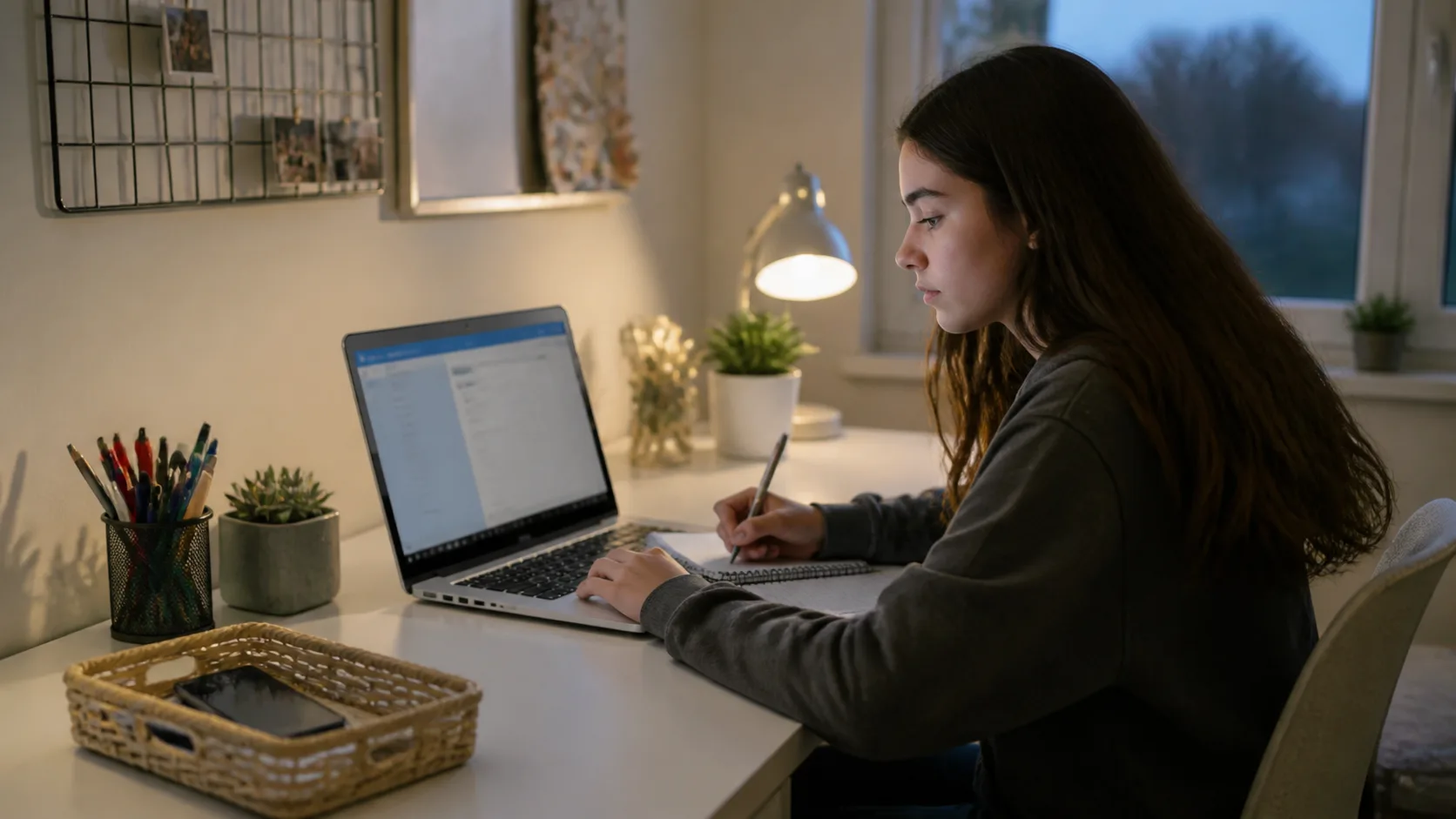
Start with a clean digital workspace. Close unrelated tabs, use full-screen mode when helpful, silence nonessential alerts, and place the phone outside arm's reach. Decide in advance when messages can be checked.
Include your child in the plan. Ask which notifications are hardest to ignore and which school tasks genuinely need communication. A rule is easier to follow when it matches the real workflow.
What parents can try
- Separate required school technology from entertainment use.
- Turn off nonessential notifications before the work block starts.
- Keep the phone in a shared charging place during focused work.
- Use one planned message break instead of frequent checking.
- Review sleep, movement, task difficulty, and hunger before blaming the device.
What if removing the phone does not improve focus?
The screen may have been the visible escape, not the underlying problem. If focus still breaks down, check whether the task is understood, appropriately difficult, and divided into manageable steps.
Persistent attention problems across many settings deserve a broader conversation with teachers and the pediatrician. Device habits can affect attention, but they should not be used to diagnose or dismiss another need.
Related parent guides
- Homework fights and how to stop them
- Executive function and missing assignments
- Ways to improve a child’s focus
Sources and further reading
These sources support the educational and health information in this guide. They are not a substitute for advice from your child’s teacher, pediatrician, or licensed specialist.
- American Academy of Pediatrics Family Media Plan current family media guidance
- AAP teen school guidance guidance on digital switching during homework