
Quick answer
California AB 3216 requires school districts to adopt policies limiting or prohibiting smartphone use during the school day, while local rules and exceptions vary. A phone-free block can reduce distraction at home, but repeated difficulty starting or completing work may point to a skill gap that needs targeted instruction.
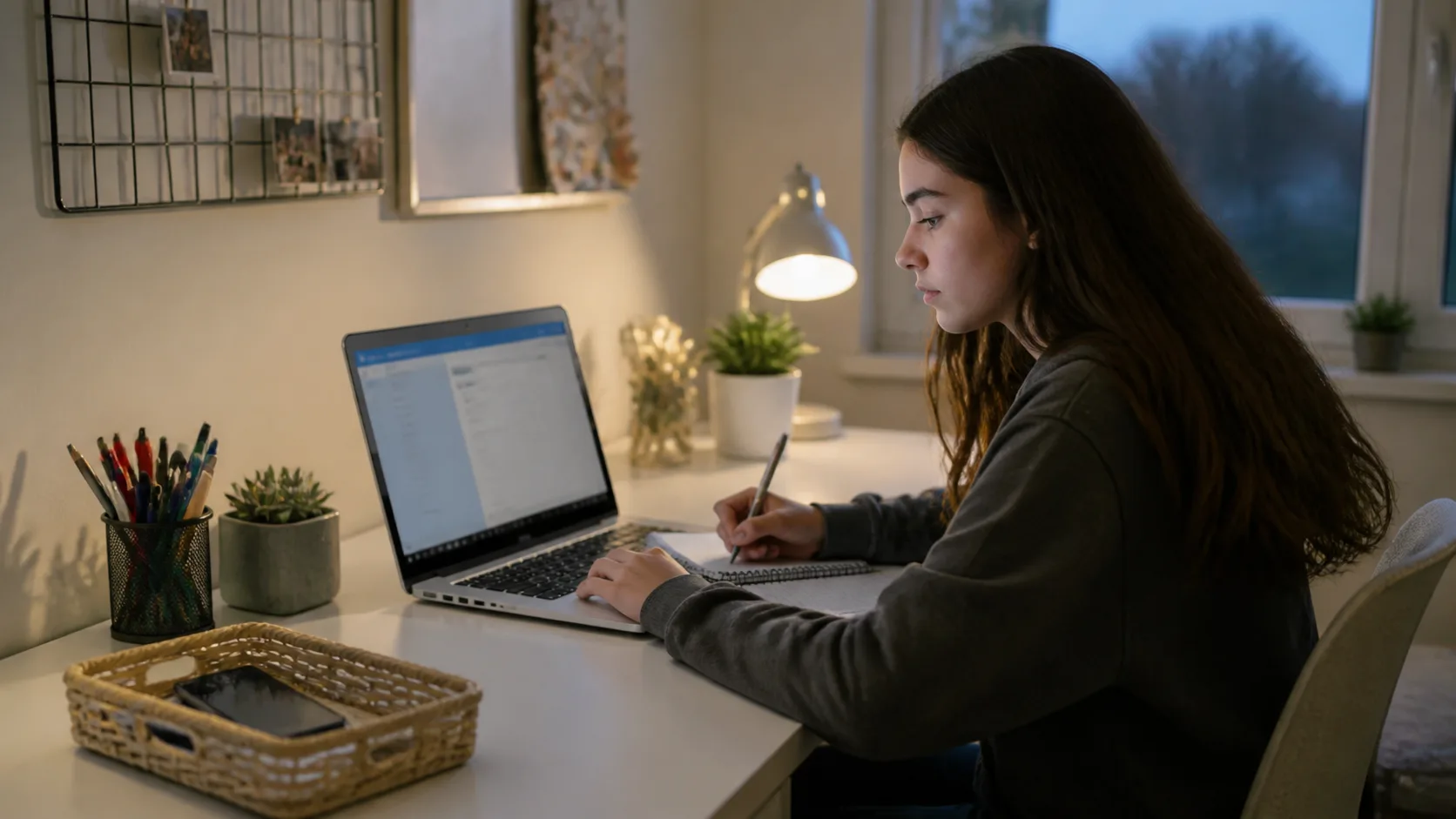
This school year, many Tri-Valley parents are hearing a new set of rules about phones at school. Here's what changed, what it can and can't fix, and what to watch for at home.
What the law requires
California's Phone-Free Schools Act (AB 3216), signed in September 2024, requires school districts to adopt policies limiting or prohibiting student smartphone use during the school day. Districts had to adopt those policies by July 1, 2026, and must review them at least once every five years.
The law sets the requirement, but each district writes its own policy. Rules on where phones are stored, which parts of the day are covered (class, passing periods, lunch), and exceptions for emergencies or medical needs vary. Check your district's and school's current policy for the details that apply to your child.
Common signs parents notice
- Your child finishes schoolwork faster at school but still stalls at home.
- Homework takes twice as long as it should, with frequent device checks.
- Your child says "I get it in class" but can't start the same work alone.
- Grades hold steady, but test scores slip.
What may actually be happening
A phone rule removes one distraction at school. It doesn't remove it at home, where most homework and studying happen. And it doesn't fix a learning gap.
Often what looks like a focus problem is a thinking gap: the child avoids the work because they don't know how to start it. Checking the phone is the escape, not the cause. When the specific skill gap is closed, focus often improves on its own.
What to do at home
- Match the school rule at home during homework. Phone in another room for a set block, such as 25 minutes.
- Watch where they stop. Note the exact problem or sentence where your child reaches for a device. That's usually where the gap is.
- Separate "won't" from "can't." If they can explain the first step, it's a focus issue. If they can't, it's a skill issue.
- Check for a repeated mistake. The same error across several problems is a mistake pattern, not carelessness.
Why GrowWise?
- Find the real blocker — focus habit, skill gap, or both.
- Structured, device-free sessions with a clear goal each time.
- Math with pattern correction; reading with evidence; writing with clarity.
- Short, specific updates so parents know what changed.
Program fit
- Academic tutoring in Dublin — small-group or 1:1
- Middle school tutoring
- Free Self-Check
Local relevance
GrowWise serves families in Dublin, Pleasanton, San Ramon and Livermore, where districts adopted their own phone policies under AB 3216. Whatever your school's rule, the at-home steps above apply.
Next step
Watch where your child stops during tonight's homework. Then take the free Self-Check or book a diagnostic assessment at 4564 Dublin Blvd. Call or text (925) 456-4606.